10 years of Home Assistant: my favorite software
April 1, 2026
Ten years ago I set up my first Home Assistant instance. I started on a VPS with a VPN tunnel to my home. Back then I was controlling my Z-Wave devices through a Vera Edge. When I switched to a Z-Wave USB stick, I made the move to a Raspberry Pi at home.
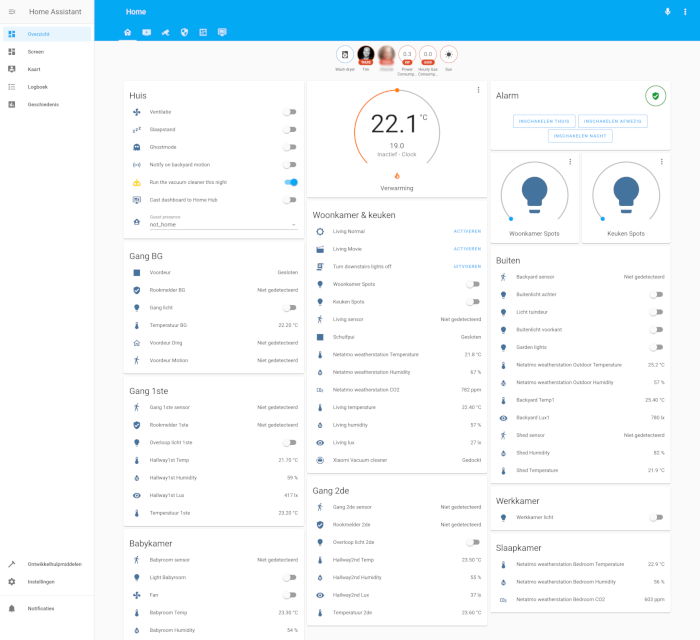
Over those ten years, my setup has grown to 71 automations, 1052 entities, 105 devices and 33 configuration files. And in all that time I’ve never had a major outage. It runs remarkably stable. My full configuration is publicly available on GitHub: github.com/TrafeX/home-assistant-config
Why Home Assistant is my favorite software
I work as an architect on software development projects, and from that perspective I look at how Home Assistant evolves with different eyes. What Paulus Schoutsen and his team have been doing for ten years is architecturally impressive: they’re building a platform with thousands of integrations, yet they keep breaking changes to a minimum. That’s no coincidence. It requires well-considered choices about abstraction layers, interfaces, and how to introduce new functionality without breaking existing setups.
The monthly release cycle helps with that. New features start rough but are refined every month. Each year they pick a central theme around which development revolves, and they work towards it step by step. You can see this in how the platform has evolved from something only accessible to people who write YAML without thinking, to something workable for less technical users too; without losing depth for advanced users.
What also stands out is how transparent this process is. Architectural proposals are discussed publicly on their discussion board, and once approved, documented as ADRs (Architecture Decision Records). Something I regularly use in my own projects as well, and it’s good to see a project of this scale taking it equally seriously.
My approach: automating without getting in the way
I want Home Assistant to work for me, not the other way around. An automation that works against you at the wrong moment is worse than no automation at all. That’s why I try to build as robust as possible. For the main lights in the house I use flush-mount modules with pulse switches, so you can always fall back to the traditional light switch. The smart layer is an addition, not a replacement.
What’s running
Lighting Motion-triggered lights in the hallway, adaptive brightness based on time of day and TV usage, outdoor lighting with person detection. And a personal favorite: an automation that flashes the lights in my son’s room for a few seconds. We use that when getting dressed is taking too long or it’s time to come eat. 😉
Security and alarm A multi-phase alarm system with three modes: away, home and night. Different sensors are active per mode. When an alarm triggers, camera snapshots are sent immediately via Telegram.
Energy and solar The washing machine and dryer start automatically when the solar panels are generating enough power. The threshold is recalculated every night based on the expected sun angle and season. Afterwards a notification arrives with the duration and consumption in kWh. Especially with the net metering scheme being phased out next year in the Netherlands, this is a useful application: you want to use your generated energy as much as possible at the moment you generate it, rather than feeding it back to the grid at a lower rate.
Household appliances Robot vacuum, ventilation based on CO₂ levels and shower usage, dishwasher notifications.
Presence Ghost mode: when away, lights turn on at random times in the evening to simulate occupancy.
Notifications and monitoring Low battery warnings, UPS alerts, mains voltage deviations, and a notification when the front door has been left open too long. I created that last one after coming home from a full day at work to find the front door hadn’t been properly closed. 🫣
Protocols and hardware
Z-Wave for Fibaro and Shelly dimmers and sensors, Zigbee for Philips Hue, Aqara and Sonoff, WiFi for Netatmo, Shelly, the SolarEdge inverter and a few Google Nest Hubs. Remote control via a Telegram bot, Google Assistant for 30+ entities, and the smart meter (electricity and gas) via DSMR.
Closing thoughts
If you’re already using Home Assistant or thinking about getting started: the barrier is much lower than it was ten years ago. But the platform grows with you. My configuration is publicly available on GitHub if you’re looking for inspiration or want to see how I’ve set things up.
Go back